Registration is now closed.
To stay updated on future film programs, sign up here.
We spend almost all of Oslo, August 31st at Anders’ side.
We follow him through a single day in Oslo — his first since a 10-month stint in rehab — as he decides whether he wants to rebuild his life or end it.
We listen to him, to how other people respond to him — and we even get access to his innermost thoughts.
The film gets extraordinarily close to what it feels like to experience this day as Anders:
- Feeling completely out of step with everyone else his age
- Struggling to imagine a future — a career, a relationship, a life — that he actually wants
- Wondering whether it’s already too late to rebuild his life — and whether he’d know how to anyway
- Seeing evidence that things are hopeless more easily than evidence that they might not be
- Feeling profoundly alone in all of it

And yet, our perspective is never simply his.
We can understand why Anders feels so alone in his fears and struggles — while seeing that he isn’t as alone in them as he thinks.
We often credit our understanding of Anders to Anders Danielsen Lie’s performance.
But there’s no facial expression for why his life looks as hopeless to him as it does from where he’s standing.

We might credit the perspective we have beyond Anders’ own to the other characters we meet.
But the film doesn’t simply give us their perspective instead.
We can experience things none of them can — because we’re watching a film while they’re living their lives.
Somehow, Joachim Trier lets us experience this day as Anders does while also experiencing it in a way Anders can’t.
The question is:
How?
Two moments, almost 40 minutes apart, give us one place to look.
The film begins with two minutes of other people’s memories of Oslo — before we even meet Anders.
One line stands out:
“How he insisted melancholy was cooler than nostalgic.”
It’s a great line.
But notice what happens around it.
In just a few seconds, you see three images of someone running away — from you, the viewer.
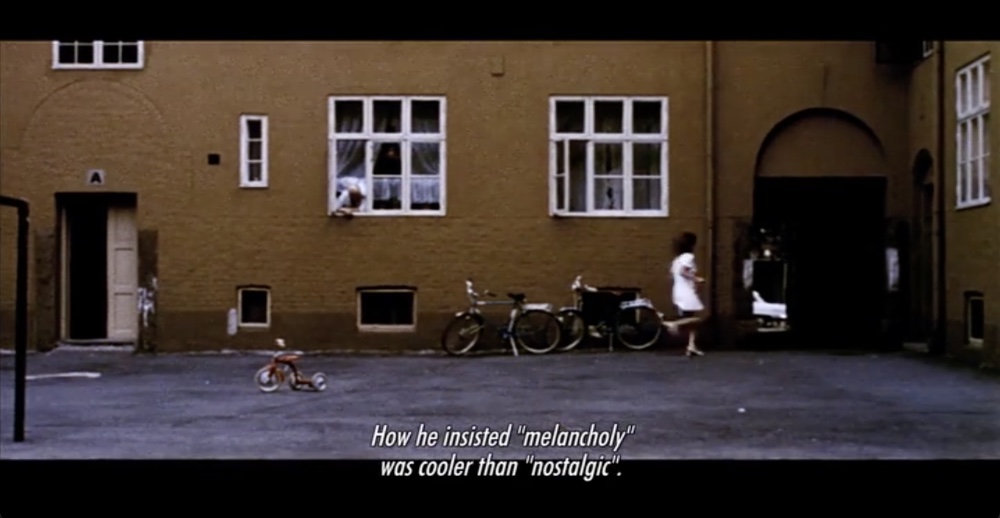
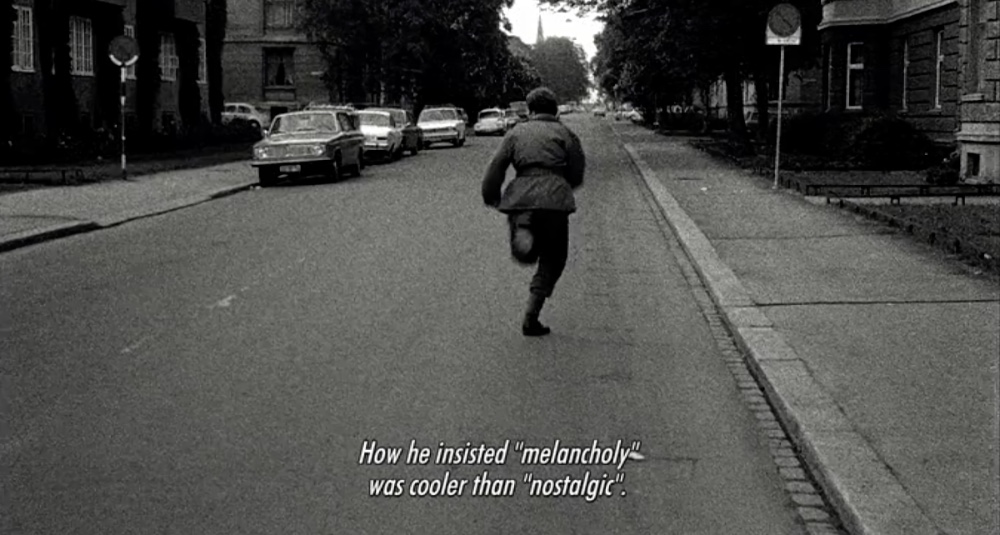
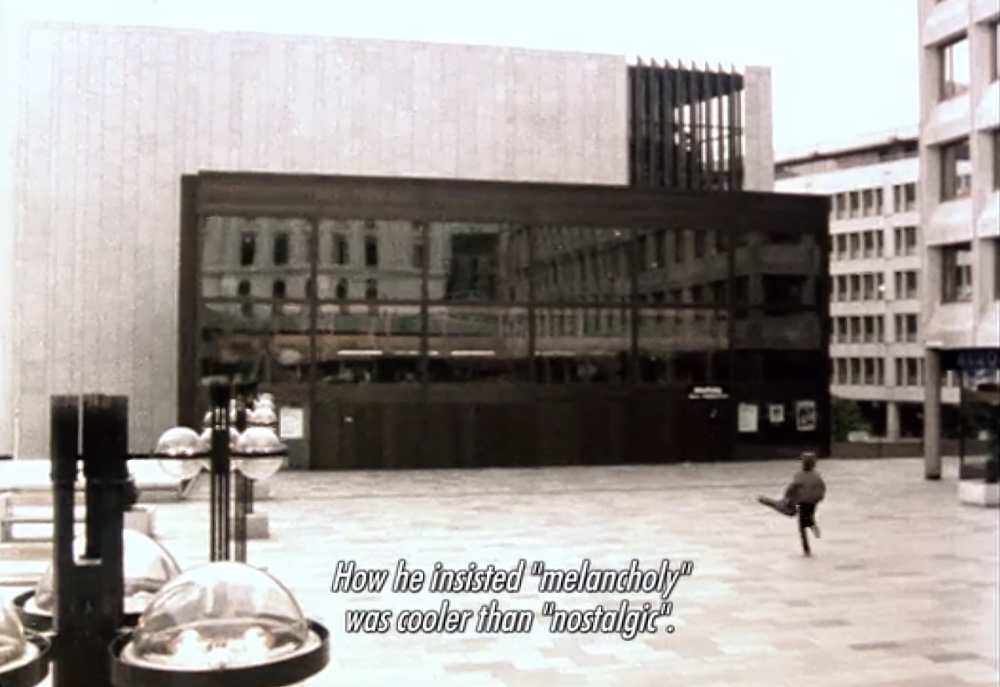
There’s a particular melancholy — and sense of abandonment — from watching someone run away from you once.
Even though we never find out who is running away.
Seeing it three times deepens that feeling — and helps us hold onto it.
Later, Trier returns to that image when Anders says goodbye to his best friend Thomas.

Thomas is walking away from Anders.
Only this time, Anders is in the frame, too. So we experience the moment with him: that Thomas is disappearing behind him.
Except Anders is walking away, too.
Turn the camera around, and the image could work in reverse: Thomas in the foreground, his best friend disappearing behind him.
The same image that brings us closer to Anders’s experience also lets us see beyond it.
And we’ve seen this image before.
In the prologue, three different people ran — not walked — away from us, into the back of the frame.
So when this goodbye echoes those earlier images, we’re not only experiencing what it means for Anders.
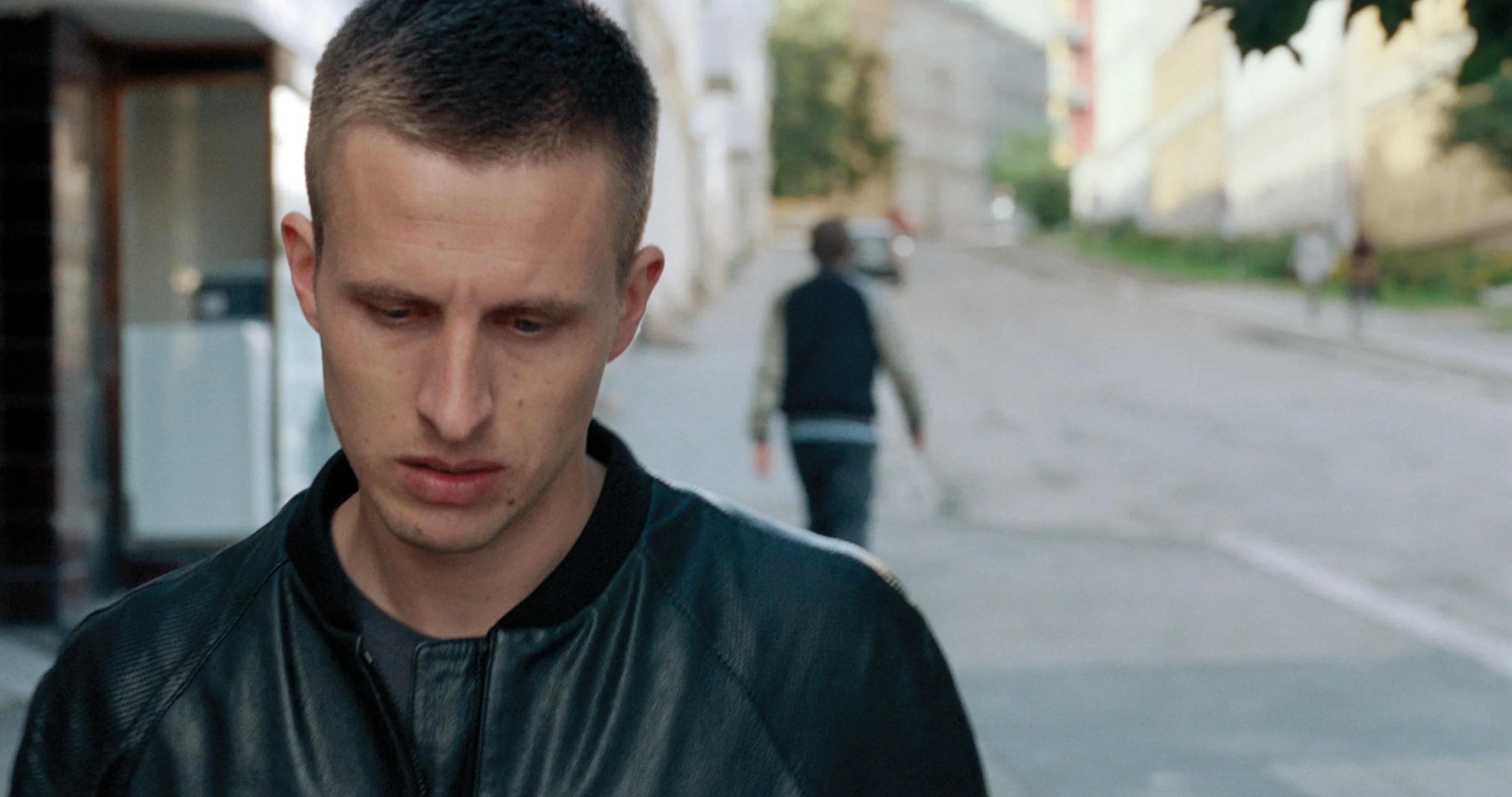
People leave. And people get left.
From Anders’s frame, Thomas walking away can become part of the accumulating case that his life has irreparably fallen apart.
But the film has given us another frame.
Relationships can change, become limited, disappoint us, fail to give us what we need — without that necessarily meaning a life has gone irreparably wrong.
That doesn’t make this goodbye any less devastating.
We can experience the loss without experiencing it as proof that everything is lost.
We looked at four images from the film — and found a new frame for Anders’ experience.
And feeling left by the people he cares about is only part of what Anders is experiencing.
What happens to our experience of the film when we find the frames Trier gives us for Anders’ fear that it’s too late to rebuild his life?
Or that he wouldn’t know how to anyway?
Or his inability to imagine a future he actually wants?
How much might our experience of Anders’ day change?
The problem is, those four images were 40 minutes apart.
And repeating an image three times in the prologue is about as close to signposting what matters as the film gets.
So how do we figure out:
What’s worth paying attention to?
Which moments belong together?
And what changes when we look at them together?
In case we haven’t met yet — I’m Alex Heeney: film critic, educator, and Joachim Trier scholar.
I’ve been studying Trier’s work for more than a decade — and now writing a book about his work.
During the live sessions, you’ll often hear me say:
Pay attention to this…
Hold onto that…
Let’s think about this…
Now connect it to what we saw earlier…
What changes?
My job is to put the right scenes in front of you, in the right order, with the right questions, so that each discovery unlocks the next.

As featured in…






Let’s look at Oslo, August 31st together inside The Deep Focus.
Over three live, small-group sessions, we’ll look closely at the film together — at how Trier brings us inside Anders’ experience, and the frames he gives us that Anders himself doesn’t have.
And we’ll see how our experience of the film shifts when we can hold both at once.
Nancy Mills described the experience of looking this closely at another Joachim Trier film:
“I feel like I have more acute vision and a better understanding of how a director influences what I get out of a film.
The live session helped me do that — and it’s made me understand it more deeply at the same time.“
We start August 27.
We meet for 90 minutes on:
Thursday, August 27
Sunday, August 30
Sunday, September 6
2:30 p.m. ET / 11:30 a.m. PT
7:30 p.m. UK / 8:30 pm Central Europe
Save your seat:
🎟️ $297 USD
or 2 payments of $175
Only 8 seats available.
Two access/concessions seats available — details in the FAQ.
What does it feel like to spend 3x a film’s runtime digging into it?
Hazel S. has done this with me three times, using three different films. This is how she describes it:
“It’s really effective to have Alex play a film, stop it every 20 seconds, and then we chat.
It’s a really good way of actually looking at how something’s put together, how it works, and what it’s doing.
That’s something this format really gives you that you can’t quite get from going to the cinema and having a coffee with friends after.
We come back within the month and have another talk about it, and something that someone said before can unlock something… the first discussion can feed into a rewatch… and then you pick out different things.
You might watch the film again and talk about it again, and it just gets richer and deeper.
Outside of academia, I just don’t think you really get that invitation to really spend time digging in.
When Alex has already picked out key points where a lot is happening with the blocking or the camera movement or something, it really helps you pay attention to those things when you’re seeing them elsewhere in the film — and in other films, too.“
So what does digging into Oslo, August 31st look like?
The film’s story unfolds largely through Anders’ encounters with other people.
But we’ll spend much of our time on what happens around and between those encounters.
Some are among the film’s biggest set pieces. Others are quiet moments that might barely register on a first watch.
Across the three sessions, we’ll slow those moments down — and use what we discover in each session to look more closely at what comes next.
Session 1: Before Anders’ day in Oslo begins

Before Anders arrives in Oslo for the day, the film has already begun shaping how we’ll experience what happens there.
We hear other people’s memories, fears, and struggles. We see images whose significance we don’t yet understand.
Only then does Anders head into the city.
By the end of the session, you’ll understand what Trier is setting up before Anders’ day in Oslo begins — and know these early voices and images well enough to recognize their echoes elsewhere in the film.
👉 We’ll meet for 90 minutes on Thursday, August 27. A recording of the session will be available afterward.
Session 2 – Anders among other lives

Anders spends the day moving through a city he knows intimately — but no longer knows quite how to belong in.
By now, we know this Oslo before we experience it with Anders.
So what changes once he enters it?
How does Trier connect Anders to the city — even as Anders increasingly experiences himself as disconnected from it?
By the end, you’ll understand how the film’s form lets us experience both at once.
👉 We’ll meet for 90 minutes on Sunday, August 30 — the day on which all of these scenes take place! A recording of the session will be available afterward.
Session 3: Alone with Anders

For our final session, we’ll return to the beginning and end of Anders’ story.
At both ends of the film, Trier leaves us alone with Anders for unusually long stretches — with very little dialogue to tell us what he’s thinking or feeling.
But this time, we’ll be looking at these moments with everything we’ve discovered in the first two sessions behind us
By the end of the session, you’ll understand these bookends in relation to the rest of the film — and see connections between two sequences that are almost 90 minutes apart.
👉 We’ll meet for 90 minutes on Sunday, September 6. A recording of the session will be available afterward.
After the last iteration of The Deep Focus: Oslo, August 31st, one participant wrote:
“The live sessions were given a great deal of thought.
Alex had already spent a lot of time with the films, analyzing the excerpts we looked at in depth.
She shared those insights while also holding space for the contributions of the participants.
Repeated viewings of sequences with and without sound allowed time to digest and discover.”
– N. Graham, USA
We start August 27.
🎟️ $297 USD
or 2 payments of $175
Only 8 seats available.
Two access/concession seats available in this round.
See the FAQs for details.
FAQs
When are we actually meeting?
We meet three times:
Thursday, August 27
Sunday, August 30 (the day most of the film takes place!)
Sunday, September 6
Each meeting is 90 minutes and starts at the following times:
11:30 am PT
2:30 pm ET
7:30 pm UK
8:30 pm Europe
We’ll start right on time, as we will need all 90 minutes!
How much time will The Deep Focus take?
- Watch the film: 95 minutes
- Live sessions x 3: 4.5 hrs total (90 minutes each)
- Optional Bingo activities: 5 minutes–3 hours (your choice)
One new element for this round of the Deep Focus is a Bingo Card with 9 optional activities you can do in between sessions that will enrich the experience.
There is no expectation that you will do them, but people who have joined in the past have done some of these and found it rewarding.
Some of them are very quick, like asking a question in the async space or commenting on someone else’s post.
Some are more involved, like watching another Trier film with one of the tools you’ve learned inside The Deep Focus in mind — or rewatching Oslo, August 31st.
Everyone who completes the card will get a prize — but each of the activities is meant to be rewarding on its own!
How many people will there be?
Each cohort is capped at eight people because this only works if everyone has room to notice things, ask questions, and think out loud.
Small enough that your observations matter—but never so small that you’re thinking about the film alone.
What if I’m worried I won’t know what to say?
The point here isn’t to show up with insights to share; it’s to look again and discover something new together.
That’s why we’ll rewatch key scenes together in short enough chunks that you can really pay attention — and I’ll guide your attention with specific things to look for as we go.
Sometimes I’ll ask you to:
- Pay attention to what’s happening in the background of an image.
- Hold onto a detail we’ve seen before.
- Ignore Anders for a moment and watch what the camera does instead.
You won’t be expected to have a fully formed insight every time you speak.
Questions, half-formed observations, and building on someone else’s idea are all part of how we think together.
In fact, listening is part of the work — to really hear what other people are saying, not just to wait your turn to speak.
Because when you listen to other people — and look again at specific moments in the film together — you discover something new that you didn’t walk in already knowing or thinking.
“I was nervous about stepping in and discussing things that I didn’t know much about. In the end, the atmosphere was accepting and welcoming, so I felt free to join in quite a bit.”
— Sarah Vincent, participant in several one-off live sessions
“The folks who join (in my experience) are overwhelmingly present/curious and not just there to sound smart.”
— Michael Borek, Reel Ruminators Member, USA
Who else joins The Deep Focus?
People come from all over. Previous cohorts of other programs have included participants from Canada, the US, the UK, Germany, and elsewhere.
They arrive with different relationships to the film and different levels of film knowledge—but they’re all there for the same reason: curiosity about film and about what other people can help them discover.
But will I actually belong? I’ve been in spaces that are accepting on paper but aren’t really in practice.
A lot of spaces say they’re welcoming on paper — and then once you’re inside, you realize you still have to brace yourself, translate yourself, or decide whether it feels worth speaking up.
That’s not what I want for The Deep Focus.
I’m a cis white woman with an invisible disability. I know what it’s like to move through some spaces feeling like I don’t quite fit. I also know I have blind spots.
Creating a genuinely welcoming space takes more than saying “everyone’s welcome” and hoping for the best.
It means being thoughtful about how the room is held, being clear about expectations, listening when something isn’t landing, and paying attention to how people are actually experiencing the space — not just how I intended it to feel.
My hope for The Deep Focus is that it feels like a space where you can show up as you are, bring your own relationship to the work, and trust that curiosity and care matter more than performing expertise.
I want The Deep Focus to be a space where people can think out loud, disagree generously, notice different things, and still feel respected and at ease.
And if something feels off, I want to know.
Because the goal isn’t just “inclusive” on paper.
It’s to create a space where people actually feel welcome once they’re inside.
What if I miss a session?
The expectation is that we’ll all plan to show up live for all three sessions — while also being human.
Life happens. Travel happens. Energy crashes. Sometimes, you have to miss something.
Every session is recorded, so if something comes up, you can catch up on the recording before the following session and return with the same shared context.
The recordings work really well as a backup for a session you have to miss.
But I wouldn’t recommend joining if you already expect to rely on them for most of the program.
We’re a small group meeting three times in just ten days, and a big part of what makes this work is everyone returning with the same shared context — and building on what we noticed together from session to session.
Plus, 90 minutes is pretty manageable to catch up on. Four and a half hours of Zoom recordings you’re planning to watch later can become a very different proposition.
The Group Space (our async forum) also stays open between sessions, so you can reflect, share, and continue the conversation — even if you couldn’t be there in real time.
So…is this the sort of thing where you join to watch the recordings?
No, it really isn’t.
The recordings are more of a back-up in case you have to miss a session.
I know from past participants that the recordings are valuable if you can’t make a session.
But the real joy of The Deep Focus is being in a room with other people where you can think together in real time.
In the live room, you get a few things that simply can’t be reproduced in the recording:
- What you notice changes what everyone else notices, which means your presence in the room changes how we approach the film. For example, if you start noticing framing — other people might, too. If someone else is really attentive to body language, it will teach you to start thinking that way, too.
- I can only adapt to you in real time. If you’re struggling to see something, I can shift what I’m doing. If you’re confused, you can ask a question about the last 15 seconds of screen time right when we watched it. Or if you get really curious about one aspect of the filmmaking, I can build on that, too. You can, of course, ask me these Qs in the group space if you’re watching the recording — but we can’t reproduce me answering your question as you have it, or everyone responding to and building on your observation in real time.
If you watch a recording, you will still get the key takeaways I’m aiming for in each session. And you will still get to hear other people’s perspectives.
Do I need to watch Oslo, August 31st?
I recommend watching it before our first session if you haven’t seen it already. If you have, you don’t need to rewatch it before we begin.
How do I watch Oslo, August 31st?
If you’re in Canada, it’s streaming on Kanopy and available on DVD.
In the US, it’s streaming on Mubi, and available to rent/buy on AppleTV or Prime Video — or you can buy it on DVD/Blu-ray.
In the UK, it’s streaming on Mubi, and available to rent/buy on VOD.
If you’re elsewhere, you can check where it’s streaming — or available to rent or buy on VOD — here.
Where will everything happen?
On a platform called Circle. If you haven’t used it before, it’s great! One login for everything, a clean UX, and an app you can download on your phone.
The live sessions will be hosted on Zoom because it’s still the best platform for it. All you need is a free account.
When is the cut-off for joining?
Wednesday, August 26 at 7 pm ET or when it fills — whichever comes first!
What happens once I join?
As soon as you sign up, you’ll get access to our online space, where you can introduce yourself to the group and get settled.
There’s also a short 7-minute onboarding survey so I can get to know the specific humans who will be in the room with us.
What if I can’t afford the full price?
If the full price would make it hard or impossible to join — especially due to disability, chronic illness, care responsibilities, uncertain employment or systemic barriers — the access rate is here for you.
I’ve set aside two access-priced seats in this round of The Deep Focus — available at:
- $148.5 upfront (50% off)
- $122.5/month for 2 months (30% off)
There’s no application and no need to explain your circumstances.
If this applies to you, just email me at contact@seventh-row.com and let me know you’d like one of the access seats.
Spots are first-come, first-served. This is one way I’m working to make sure the space reflects the richness of our wider communities — while also keeping it sustainable for me as the facilitator.
What if I need an accessibility accommodation?
I’ll do my best to accommodate you — whether it’s a disability need, a language need, or something else.
Just email me at contact@seventh-row.com and tell me a little about what you need, and we can talk through what might help.
If it turns out The Deep Focus isn’t the right fit for those needs, I’ll be honest about that, too.
A few things that might be helpful to know:
- We meet on Zoom where auto-captions are available
- Cameras aren’t required, though I do encourage you to have yours on if you can, because it helps us all connect.
If you’re not sure whether something counts as an accessibility accommodation, feel free to ask anyway.
What if I change my mind — is there a refund policy?
If you register and find The Deep Focus isn’t for you, you’re welcome to request a full refund any time before the first live session.
If after the first session, you decide you want to leave, I will refund everything except for $65 — so you only pay for the session you attend.
After that point, I don’t offer refunds — both because the real-time content is a huge part of the experience and because you’ll have access to one-third of the program.
My hope is that this gives you space to dip your toes in and trust that you’ll know if it’s the right fit.
I have another question…
Great! Send me an email at contact@seventh-row.com, and I’ll get back to you ASAP. Messy thought dumps are always welcome!